Salmon Farming and Antibiotics: Why Ordinary Tasmanians Should Care
Antibiotics are among the most valuable medicines humanity has. Every time they are used, however, bacteria are given another opportunity to learn how to survive them.
That is why antibiotic use in open-net salmon farms is not just a fish-farming issue. It is a question about the future effectiveness of medicines, the health of our waterways and the way we protect the wider community.
What is an antibiotic?
An antibiotic is a medicine used to kill bacteria or stop them multiplying. We rely on antibiotics to treat infections in people and animals and to make surgery, cancer treatment and many other forms of modern healthcare safer.
When antibiotics stop working, an infection that was once easily treated can become much more difficult—and sometimes impossible—to cure.
What does “antibiotic resistance” actually mean?
People do not become resistant to antibiotics. Bacteria become resistant.
Imagine spraying weeds. Most die, but a few naturally tougher weeds survive. Those survivors produce more weeds with the same ability to withstand the spray.
Antibiotics can create similar pressure on bacteria. Susceptible bacteria are killed, while bacteria with natural resistance may survive. The survivors can multiply and can sometimes pass resistance genes to other bacteria.
Over time, repeated or poorly controlled antibiotic use can help produce bacteria that ordinary medicines no longer kill. These are commonly called superbugs.
How are antibiotics used on salmon farms?
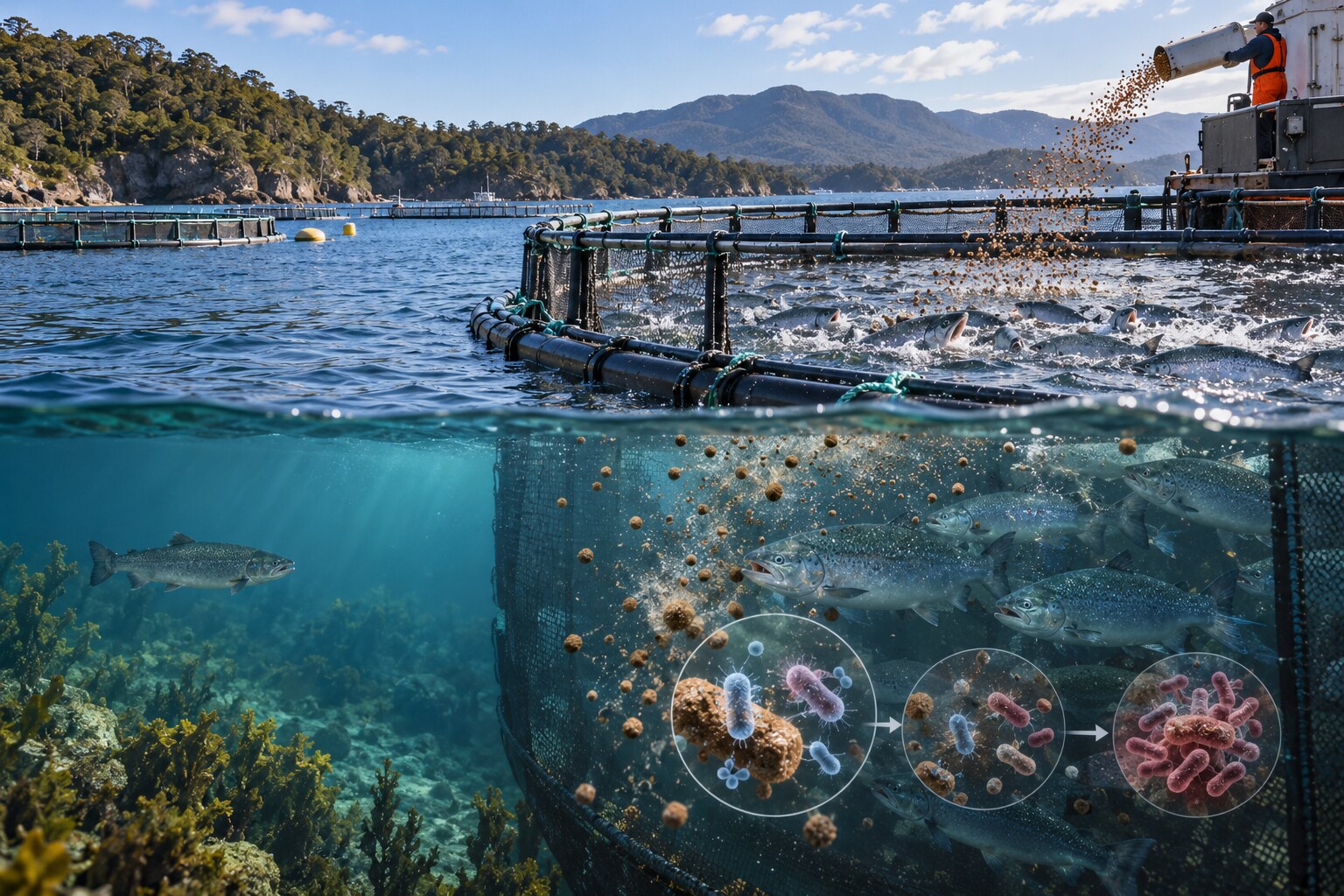
Antibiotics are generally mixed into feed so sick farmed salmon consume the medicine. They are not necessarily poured directly into the sea.
But open-net pens are not sealed tanks. Water continually moves through them. Some medicated feed may not be eaten, and treated fish can pass antibiotic residues and bacteria into the surrounding environment through waste.
That means treatment occurring inside a pen cannot automatically be assumed to remain inside that pen.
Why does this matter?
Antibiotics entering the marine environment may expose bacteria in water and seabed sediment to the medicine. That exposure can create conditions favouring resistant bacteria.
The concern is not simply that a person will swim near a salmon farm and immediately become ill. The larger concern is that resistance can develop and spread gradually through connected systems involving farmed animals, wild animals, water, sediment, food production and people.
The World Health Organization recognises that antibiotic use in aquaculture can contribute to the development and spread of resistant bacteria and resistance genes. Australia follows a “One Health” approach because human, animal and environmental health cannot be separated.
What happened in Tasmania?
Florfenicol was authorised under an emergency permit in November 2025 to treat a serious bacterial disease affecting farmed salmon in south-east Tasmania.
Residues were later detected at low levels in some wild, non-target fish. The Australian Pesticides and Veterinary Medicines Authority suspended the permit from 4 March 2026 because of unacceptable risk of residue exposure to non-target species. The Tasmanian EPA states that florfenicol can no longer be used under that permit.
The EPA subsequently concluded that the measured residues presented a low risk of unacceptable harm to the aquatic environment. However, that assessment expressly excluded bacterial communities. This matters because bacterial communities are central to the question of antibiotic resistance.
Public Health advice also found that eating typical amounts of the tested wild fish did not pose a health risk. That is reassuring, but food-residue safety and antibiotic resistance are different questions. A residue may be below a level expected to poison a person while still requiring investigation for its effects on bacteria in the environment.
Why treating disease is not the whole answer
Sick fish should not be left to suffer. There will be times when veterinary treatment is necessary.
But repeated disease across intensive farms should trigger a larger question: what conditions allowed the disease to spread so widely?
If large numbers of fish must repeatedly receive antibiotics to remain alive, regulators should examine stocking levels, fish stress, water conditions, disease prevention, vaccines and whether the farming location and method remain suitable.
Antibiotics must not become a substitute for correcting the conditions that contribute to disease.
What needs to change
- Every antibiotic treatment must be publicly reported, including the drug, quantity, location, reason and treatment dates.
- Water, sediment, farmed fish and nearby wild species must be independently tested.
- Monitoring must look for resistant bacteria and resistance genes—not only chemical residues.
- Repeated outbreaks must trigger an independent review of stocking levels, fish welfare and farming conditions.
- Antibiotics that are critically important to human medicine should face the strictest controls.
- Companies must demonstrate that vaccines, prevention and lower-risk alternatives were considered first.
- Test results should be published promptly in language the public can understand.
- Wild fisheries, recreational fishers and nearby communities must be warned immediately when residues are detected outside farm pens.
This is not about denying treatment to sick fish. It is about protecting the medicines that human beings and animals may desperately need tomorrow.
Tasmania’s waters are connected ecosystems. Once antibiotic residues, resistant bacteria or resistance genes leave an open pen, they cannot simply be called back.
That is why the safest approach is prevention, minimal use, independent monitoring and complete public transparency.
Sources
- World Health Organization: Antimicrobial resistance
- World Health Organization: Antimicrobial use in aquaculture and antimicrobial resistance
- Australian Government: Australia’s Antimicrobial Resistance Strategy
- APVMA: Suspension of the florfenicol permit
- EPA Tasmania: Florfenicol
- EPA Tasmania: Environmental risk assessment of florfenicol use, 2025–2026